LEGO Minigun
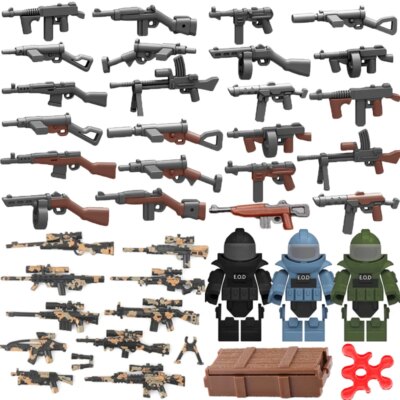
The LEGO minigun is the most dramatic weapon in any military collection—six barrels spinning at up to 6,000 rounds per minute, driven by an electric motor that Richard Gatling’s 1861 invention inspired and that modern engineering made terrifyingly real. In brick form, the hexagonal barrel arrangement is the defining visual feature, and a well-built minigun model at minifigure scale creates an immediate, visceral impression of firepower that no other weapon accessory can match.
Showing the single result
Showing the single result
The Minigun in Display Context
The M134 minigun is too heavy for infantry to carry — at 41 pounds without ammunition, it requires a vehicle, helicopter door, or fixed mount. This actually makes it more interesting as a display element, because it always appears as part of a larger system: a Black Hawk helicopter door mount, a Humvee ring mount, or a fixed defensive emplacement with a generator and ammunition feed system.
At The Brick Battle minigun sets connect to the military arms build range weapons hub, the weapon accessory range complete armaments collection, the squad support gun build machine gun predecessor range, and the rotary cannon build historical Gatling ancestor. For the helicopter platform that makes minigun displays most dramatic, the lego black hawk UH-60 range and lego military helicopter collection broader helicopter range give your minigun the airborne mount it needs to recreate the iconic door-gun image of modern military aviation.
Lego Minigun — Frequently Asked Questions
Can a minifigure carry a minigun? In display terms, yes — but historically no. Most collectors mount the minigun on a vehicle or helicopter door rather than having a figure carry it, which is both more accurate and more visually dramatic.
What is the relationship between the Gatling gun and the minigun? Direct descent — the M134 operates on exactly the same rotating-barrel principle that Gatling invented, just powered by electricity rather than a hand crank. General Electric explicitly named the design principle in its designation.